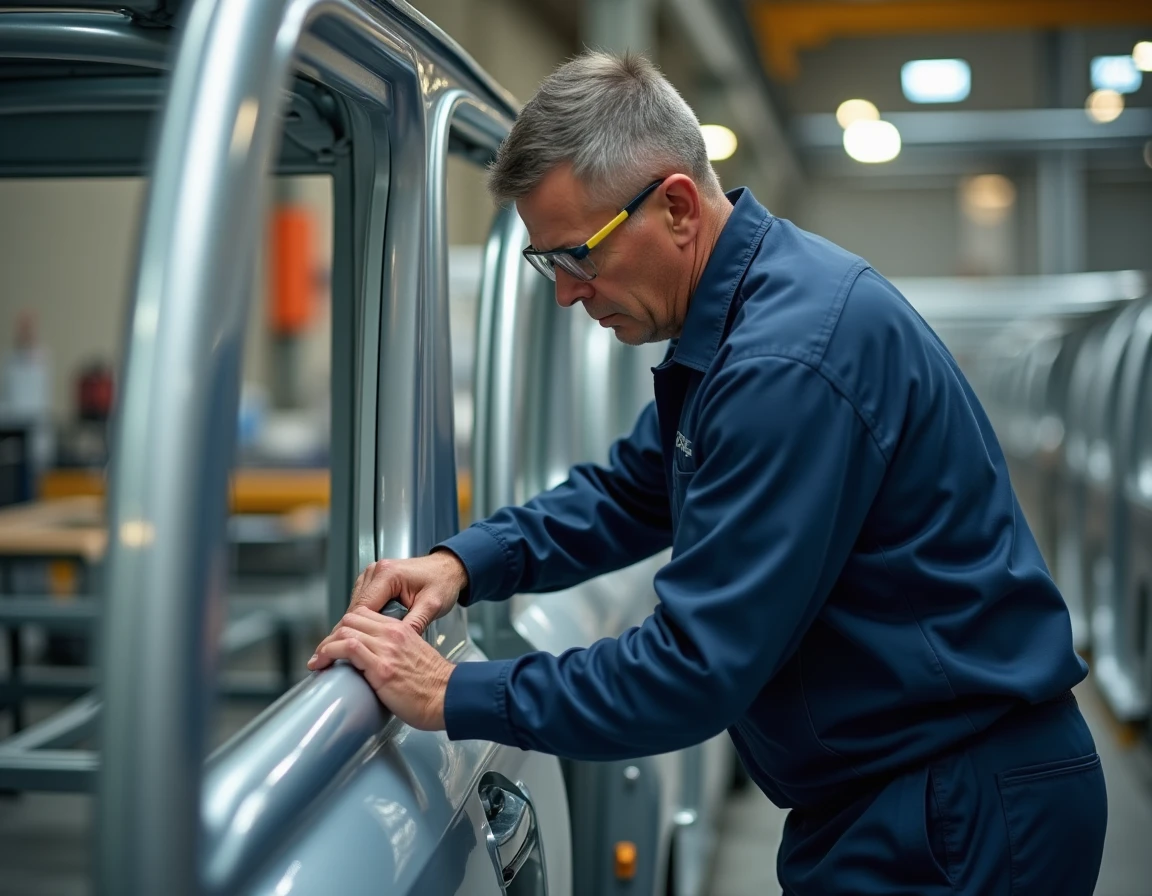
Rubis is not an independent manufacturer. It is a trade name associated with the Trigano group, produced on the Caravelair lines. The Rubis 2027 continues this industrial logic by incorporating technical choices that distinguish it from the rest of the catalog.
Chassis and structural design of the Rubis 2027 in relation to braking standards
The European safety updates (braking, stability, anchoring) gradually implemented since 2024 have required a complete revision of the chassis and the weights in working order for the 2027 models. Trigano, through Caravelair, had to rethink the load distribution so that each Rubis configuration remains compatible with a category B license in most combinations of towing vehicle + caravan.
This work focuses on optimizing the maximum authorized weight. The challenge is simple: to add the safety equipment required by regulations without exceeding the threshold that would require the user to obtain a trailer license. For the Rubis 2027 caravan, the solution involves a reinforced polyester floor substructure and a framework combining solid wood and composite, two materials that offer a favorable rigidity-to-weight ratio.
The polyester floor serves a dual purpose: it eliminates the risk of moisture ingress from underneath (a recurring problem with older ranges that had wooden floors) and it lightens the structure by several kilograms compared to a traditional sandwich floor made of plywood.

Waterproof shield and XPS Styrofoam insulation: Rubis’ anti-moisture doctrine
Moisture remains the primary cause of depreciation for a caravan. Rubis has applied a principle of waterproof shield where all materials in contact with the outside are rot-proof for several generations. The reinforced polyester roof, the walls with bonded aluminum profiles, and the polyester substructure form a continuous envelope that leaves no entry point for water.
The insulation is based on XPS from Styrofoam, recognizable by its blue color. This choice is not trivial: XPS retains its insulating properties even in the case of residual condensation within the wall, unlike traditional expanded polystyrene, which absorbs water over the seasons.
Inside, wood remains the preferred material for the framework and fittings. The wood/composite combination strengthens the structure while maintaining a more pleasant interior atmosphere than a 100% synthetic covering. We observe that this combination ages better than the all-composite solutions adopted by some German competitors.
Rubis 2026-2027 range: models, layouts, and electrical equipment
The current range includes several models with distinct layouts. Each targets a specific use.
- The Rubis 495 M is the high-end model with its large shower, water heater, gas heating, SNCF blinds, and mosquito nets on all windows, a slatted bed base, white aluminum wheels, and a redesigned bumper. It is a true mobile studio in a spacious format.
- The Rubis 410, more compact, retains a central bed and optimized storage for couples who prioritize maneuverability over size.
- The Rubis 395 targets caravaners looking for a short model that is easy to tow with a modestly powered vehicle, without sacrificing useful interior space.
The transition to fully electric functions (LED lighting, ventilation management, integrated USB sockets) marks the 2026-2027 collection. Mechanical controls are being replaced by centralized control panels, simplifying maintenance and reducing wiring.
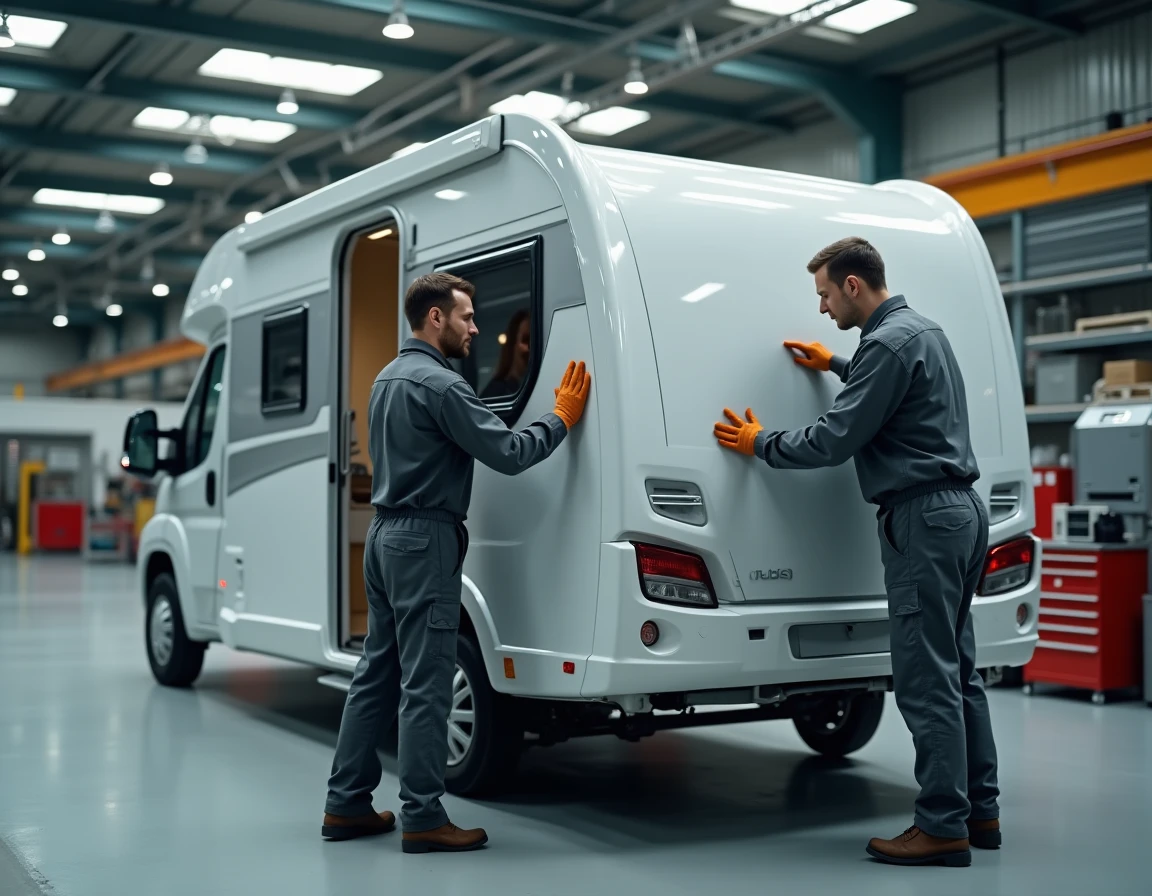
Interior layout and central bed
The central bed remains the dominant configuration in the models of the range starting from the 410. This choice allows for a circulation space on each side, facilitating nighttime access without waking the other occupant. The storage under the bed utilizes the full width of the caravan, offering a storage volume rarely matched in this segment.
The shorter models adopt a lift-up bed or a convertible bench. The quality of the bedding (with a slatted bed base standard on recent models) places the Rubis above what most entry-level French caravans offer.
Trigano and Caravelair: the industrial sector behind the Rubis brand
Rubis no longer appears as a standalone manufacturer in European homologation databases. Since the mid-2020s, the brand operates as a product line within the Trigano group, more specifically under the Caravelair entity. Administrative records confirm this affiliation.
This integration has direct consequences on the availability of spare parts and the distribution network. A Caravelair dealer can technically provide after-sales service for a Rubis, which expands the geographical coverage compared to an isolated artisanal manufacturer. Fabre Caravanes, for example, positions itself as the exclusive Rubis dealer in several departments in southern France (Carcassonne, Toulouse, Tarn, Ariège).
Supply and delivery times
The production of Rubis follows the industrial pace of Caravelair, with shorter series than the group’s flagship models. We recommend ordering early in the season, as volumes remain limited compared to demand. Some 2026 models were still available immediately from partner dealers, but the 2027 models generally require advance reservation.
The relative rarity of the Rubis in the used market maintains a stable value. Well-maintained models, with a maintenance record from an authorized dealer, resell without significant depreciation, indicating that the technical reputation of the range withstands the test of time.

The Rubis 2027 remains anchored in a French manufacturing logic, supported by the Trigano/Caravelair industrial tool and by technical choices (integral polyester, XPS Styrofoam, wood/composite framework) that prioritize durability over catalog appeal. For caravaners looking for a model designed to last several decades without infiltration, this range deserves special attention when comparing market offers.